My Grandma From 1950 Is Staring At Me As I Write: An Interview with Diana Khoi Nguyen
Diana Khoi Nguyen is a poet and multimedia artist who doesn’t limit her creative impulses. She has authored two collections of poetry: Ghost Of (2018) was a National Book Award Finalist, as well as a recipient of both the 2019 Kate Tufts Discovery Award and the Colorado Book Award, while her sophomore collection, Root Fractures (2024), was named one of Time’s must-read books of 2024. Her poetry and prose has appeared widely in magazines and journals such as Poetry, American Poetry Review, and PEN America. Her video work has been exhibited at the Miller Institute ICA and was selected for the Silver Falls Film Festival. She is a Kundiman fellow and member of the Vietnamese artist collective, She Who Has No Master(s). Winner of the 92NY “Discovery Poetry Contest,” she has received support from the National Endowment for the Arts, Breadloaf Writers Conference, Sewanee Writers Conference, and Provincetown Fine Arts Work Center. She’s an Associate Professor at the University of Pittsburgh, teaches in the Randolph College low-residency MFA, and also happens to be Epiphany’s current guest Poetry Editor. She chatted with me about her writing, her communities, and how art outside of writing has helped her stay true to a creative life.
Barclay Ann Blankenship: I’d love to start by talking a little bit about your work and the recognition it's received. Your deeply personal debut collection, Ghost Of, was named a National Book Award finalist, which is incredible and, I imagine, also a little intense. How did that impact your life, especially considering how intimate the subject of the collection is?
Diana Khoi Nguyen: It wasn’t even on my radar as a possibility. The way I found out that I was long-listed was by getting all these crazy texts from friends that I hadn't heard from in a while. I was not prepared and didn’t really understand what it meant at the time. It all felt like a whirlwind. I assumed that the book would only live on the shelves of my friends, let alone be considered for a National Book Award. I say a lot of things in the book that I wasn’t sure I was ready to talk about, even though it was public. It was really overwhelming. And moving. I grappled with what to do with that kind of attention. I felt like I had suddenly walked into a crowded room and everyone was staring at me.
It was terrifying. I realized that I’m not a person just obscurely making for myself anymore. I had to try to figure out how to go back to that place where I was making art purely, trying not to think about all the eyes…And the eyes aren’t bad eyes. It can just be too much pressure.
How did you get yourself back into that pure state?
I really leaned into creative play in multiple ways. I haven’t published any, but I wrote some plays. I started doing more video work. And then it came to a point where I remember thinking, “What do I even write after that first book?” Every time I tried to write a poem, it just kind of felt like a rejected poem from that first book. An aftershock. Not a fully formed thing. That was a stressful feeling. So I focused on considering what the opposite of image and text is. Prose and sentences? And I was like, “Great, let’s write some sentences!”
What sort of writing were you engaging with to shift your mindset like that?
I was obsessed with Jenny Erpenbeck, the German writer, and reading translations of her work by Susan Bernofsky. I loved her sentences. I studied the structure of Bernofsky's translation of Erpenbeck’s Visitation, especially. And I started writing prose poems, trying not to focus on subject material. I'm not sure what your writing process is like, but for me I find that if I try very hard to write about a particular thing or concept thing, it ends up being about something else.
Absolutely. Letting the poem show itself to you as you write through it, even if it’s frustrating, at times.
For sure. I was trying to do these complex sentence structures and fill it in with my own material. One sentence would come out okay, and then another and another, and then all of a sudden here we go. I would think to myself, “Am I ready? Okay. Yeah. I guess so?” I did that for a few years and it was fun. I was excited by the language again. I was feeling kind of wobbly about the material, but I think this is a good feeling because you don't want to feel like you're a genius. The brief moment when you think you could be a genius brings nothing but garbage. At the same time I also returned to the images from Ghost Of. For a while I was returning to them every anniversary of my brother's death. Not to try to make poems, but just as a way to just remember him. That's part of my anniversary of his passing. Sometimes those moments would lead to something on the page as well.
What became of that work that was so tied to your first collection?
I knew they weren’t to publish. It was just for me. Ultimately, I think of those images as a kind of altar to him, or a space of gathering for me and my family and those who knew him. Thinking of the images as an altar also let me be playful in that kind of space. Sometimes, in my playfulness, I would find myself crying, realizing the seriousness of what I was reckoning with, and have to take a break for a few days. This was all me trying to find a way to not think about the fact that I wasn’t an obscure, unknown person anymore. I had to go back to a way in which I had joy and challenge and difficulty in writing. I also want to make sure that the work that I choose to be public also functions as something larger than me.
I think Root Fractures speaks a lot to that scope.
I’m thinking a lot more about community now, and especially the Vietnamese diaspora beyond just me or my family. Sure, my writing is rooted in family and subjective experience, but I don't want it to be all that it is.
There’s a kind of biographical lens that can sometimes be prescribed to poetry that is deeply personal, like your own. When you interact with your writing, even the writing of others, how are you considering that line between truth and slant?
In my own writing process, I’m not writing an accounting of a diary or a journal. I love a journal, but that’s also not what poem writing is for me—it’s an intentionally crafted space. I want to make sure that I can access a wide range of feelings in me. This can include unseemly things, things that I would never say out loud or that I don’t want to admit to myself. The page is a space where I don’t get to filter that shit. More than anything, I hope not to censor myself. I lean into what’s happening on the page and look for how else can I help it to happen?
Avoidance, and then pushing into the bruise.
Exactly. I’m trying to get to the point where I surprise or shock myself. It’s as if you arrive at a kind of truth for yourself that was there all along, you just didn't know it yet. If I think of a poem as an object, that object has everything to do with you, but also nothing to do with you. You are laboring in service of the poem. It's something outside of you. It’s not quite a mirror, but a stage, a performance space—it’s play. It’s a dollhouse to experiment and do weird things in. Once you feel an undeniable moment of resonance, then you'll know you've struck something really important.
Your writing feels unafraid to let the blank space of the page, the music of the blank space, be as loud as the text itself. Those things interact with each other powerfully. Do you consider that when you’re thinking about an image?
Always. I think that text is an image. It’s a sign, it’s a symbol. An “A” is an image of an “A,” which represents a sound. In that way, it’s all marks on a page, but the white space is also a mark on the page. I think a lot about absence and presence. I want to make sure that the intentionality of whatever I do on a page is not a byproduct. If the page is a kind of sheet music the white space is what allows my eyes to travel across that space. Even if we don’t measure it explicitly, it takes X number of milliseconds for the eye to travel. So if I read it out loud, I have to take time to slow it down. How can intentional, quiet, non-utterance be a window for what else is there? The white space, or the absence, is not nothing. It’s still a framework around whatever is there.
Your work is so multifaceted. Do you interact with an image first and then dive into a poem? How do they play on one another as two physical forms that can mold?
Oh, I love that you used the word mold. It certainly is collaborative. Usually, at any given time, I have various images that puncture me and make me feel a kind of delight. I let them sit with me for a long time. Sometimes even over a year. Sometimes when I’m sitting down to write, I’ll watermark the image so it’s looking at me as I’m writing. There’s a way in which my grandma in 1950 is staring at me as I write these lines about motherhood.
It sounds like those images are crossing that creative threshold of time with you.
Something different happens if I’m writing with the images beside me, literally on my page, versus if I'm trying to describe the image or if I’m trying to pair it after the fact. I feel like I’m really spending intimate time with the images, and the writing that emerges is from that time spent with those images. Sometimes that means I’m also manipulating images, but what I don’t do is write something and then try to fit it into an image or then pair it with an image. The image is with me and then the text emerges. It was such a gateway moment to work with the familial images of Ghost Of.
Now that I’ve done that image text work, I don’t feel shy to play around with images. I also don’t feel like I’m cheating on writing by doing video work or work in other kinds of mediums. I think it’s all part of the same impulse. Sometimes I don’t have words! Sometimes I want to tear stuff or I want to collage or I want to weave with it. Writing is composing impulse. And at first I thought I couldn’t say the same thing in more than one medium. But why should I censor myself? I’m adapting work or creating impulse in a different genre or mode. It’s okay if there’s some repetition because who knows what the final version will be.
Can you speak more to those other forms that draw you in? Your creative companions.
Paintings right now, especially. I’m actually looking at one right now because I made it my desktop screen recently. It’s this painting by the Swiss painter Dominique Appia. It's so bizarre and incredible. I can’t stop thinking about it.
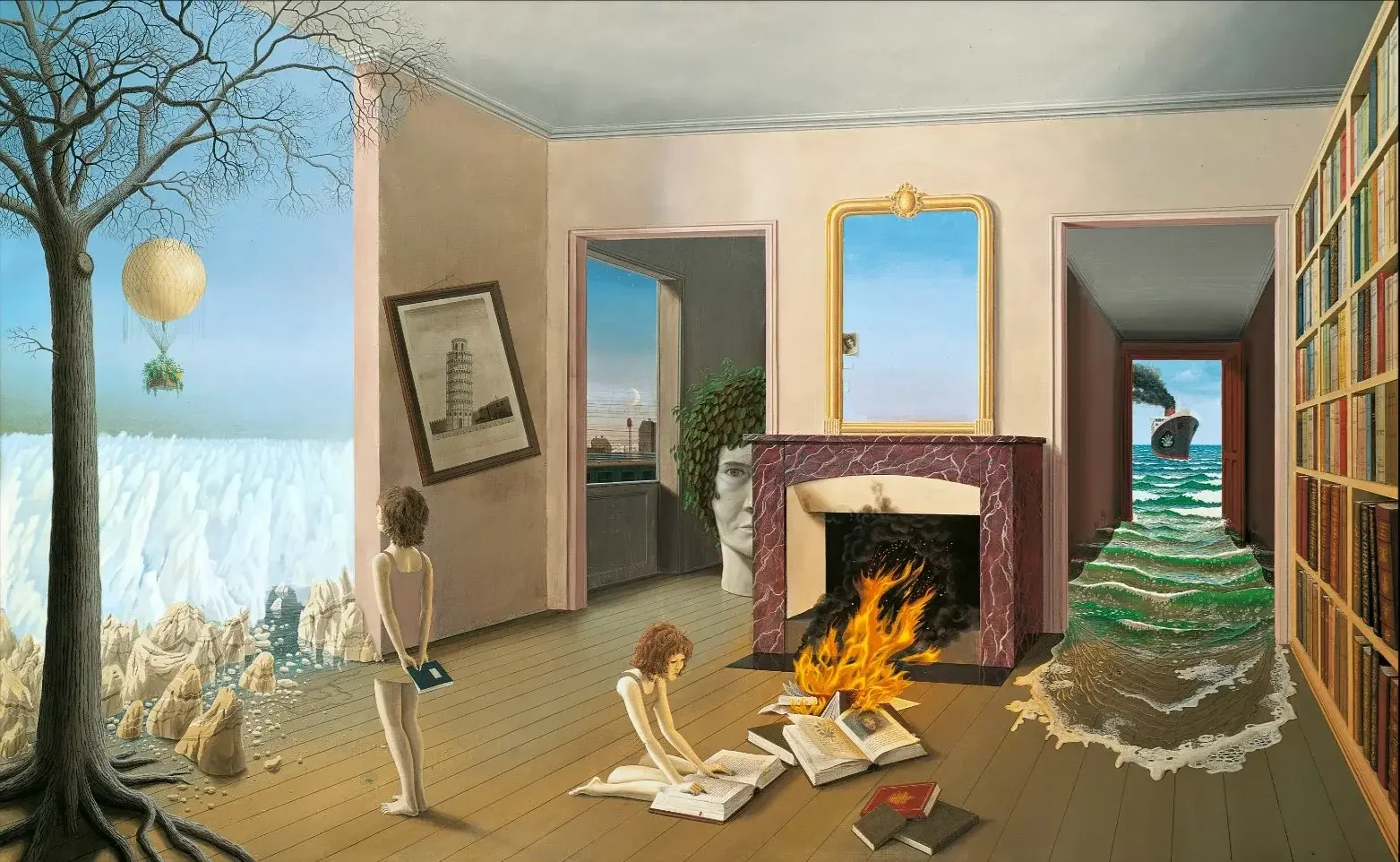
Dominique Appia, Entre les trous de la mémoire (Between the holes in the memory), 1981
I've also been obsessed with these Peregrine Falcons that nest on The Cathedral of Learning [at the University of Pittsburgh]. The building is this gigantic 36-floor tower, and there’s a camera by the nest that tracks their mating and laying eggs every year. I’ve been following the nest since I moved to Pittsburgh. When I was pregnant they were nesting. I’ve actually been writing about that and other kinds of birds, which is so weird. I’m like, “What am I doing?” At first I thought, “Oh, how cliche another poem about birds.” Now it’s actually churning up things I have not written about, like long-term monogamy and marriage, and difficult feelings in parenthood or motherhood. I’ve never written about these things explicitly, so that feels personally risky. Emotionally risky. But that’s okay, because nobody has to see it yet!
I started weaving again a year ago and then realized the last time I had been weaving was when my brother was alive. I stopped weaving when he died without realizing it. I’ve been weaving my triptychs from Ghost Of. I almost feel kind of embarrassed about this, but I just felt compelled to do it. So I’ve been exploring absence and presence on the loom. It’s a nonverbal activity and a space that’s been really nourishing for me. The weaving is totally related to the birds because I’ve been trying to make nests, which is ultimately a woven structure. So it’s all interconnected, and who knows what’s going to happen. But I’m having fun and I’m feeling nervous, which I think is a good sign. The main thing is as long as I don’t feel bored.
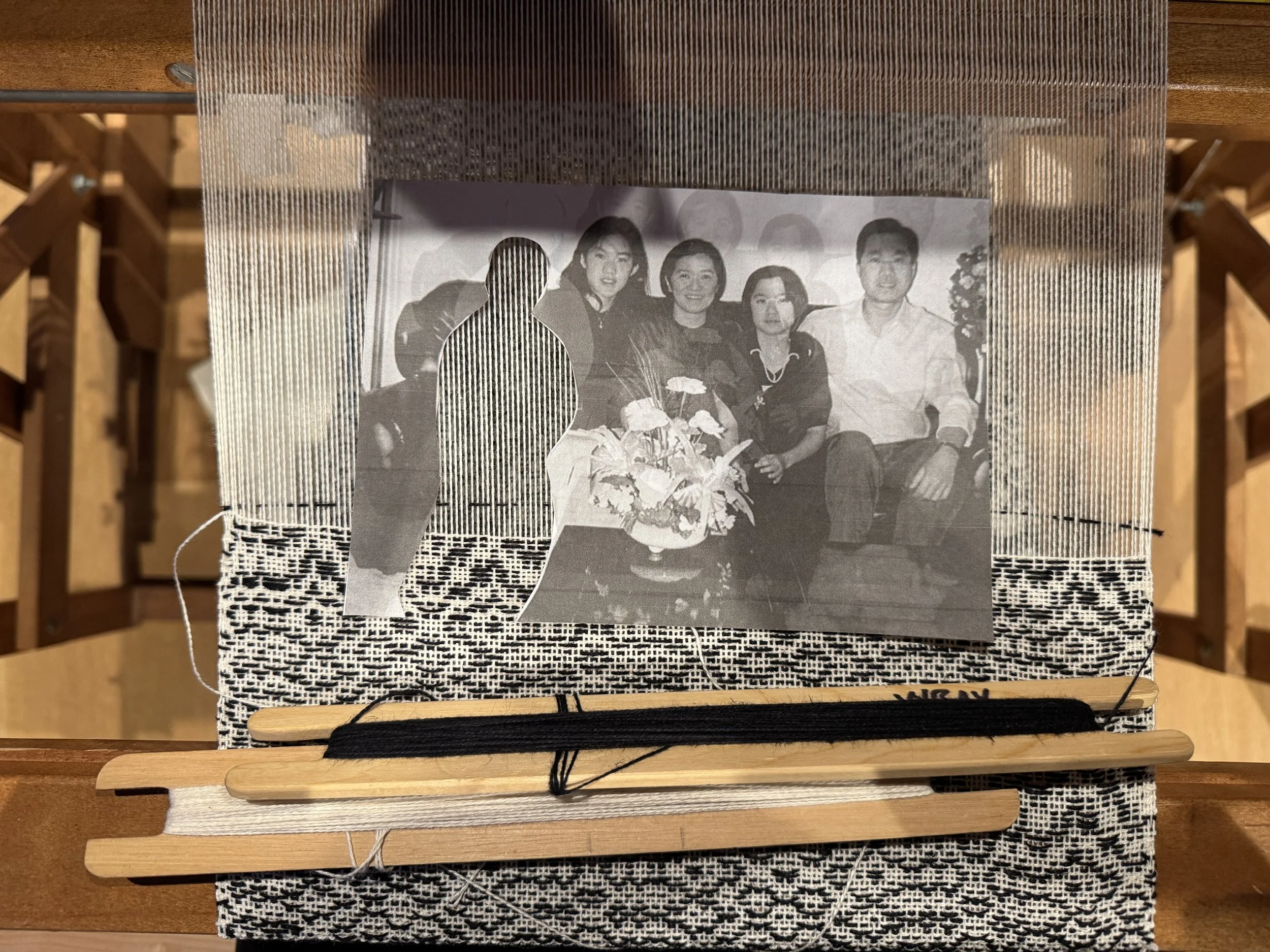
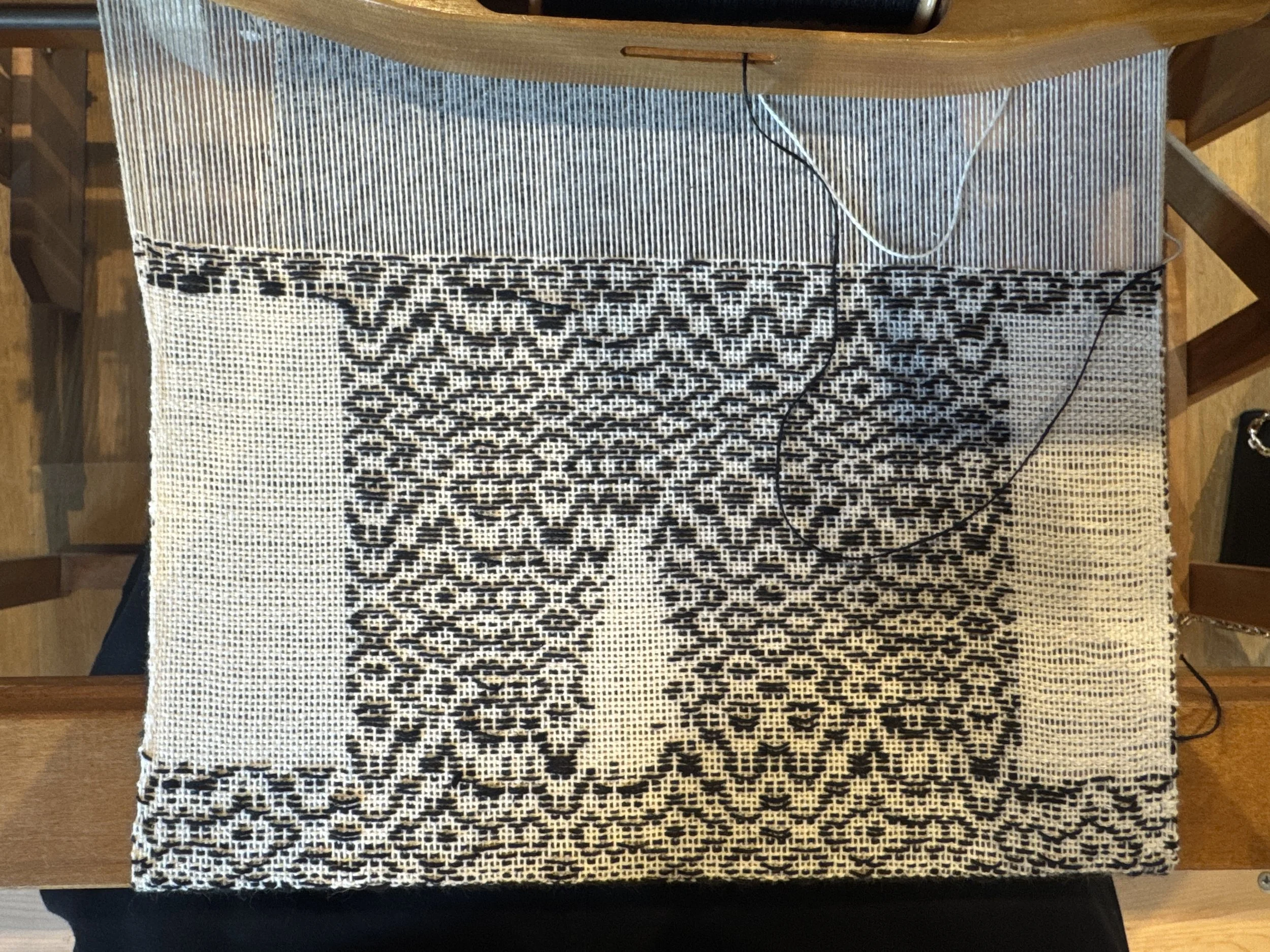
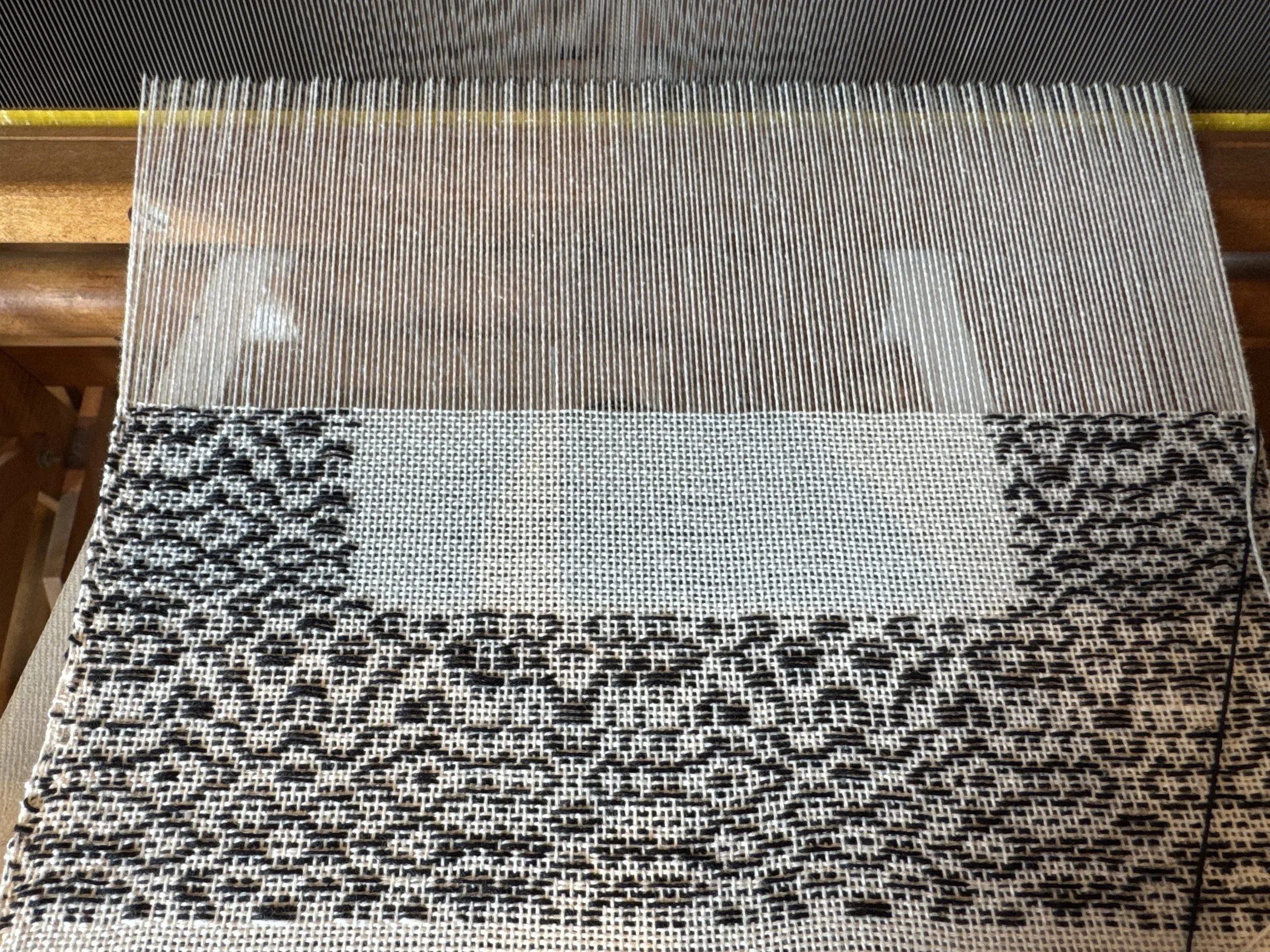
Diana’s weavings of the images from Ghost Of (2018) used in the series of “Triptych” poems
I think that’s a real fear for any creative person. Being bored.
That’s what drew me to making the nests! It’s so hard to make a nest by the way. I’m trying to make them with my own materials. I had a poem that I had been working on that made me feel so emotionally hungover, so I shredded it and then used it for the nest.
That sounds cathartic.
Oh, totally. I didn’t want to delete it, but thought that maybe I could repurpose it. So then I was weaving it with twigs and all the twigs snapped, so I started to use grass. By then I was using weeds to weave. I got a haircut and I took some of my hair from the haircut for the nest. I thought to myself, “I don’t know what’s happening. This is so weird.” All of the sudden my hands were itchy because of the spikiness of the hair.
But you’re following that impulse. You’re not censoring.
Yes! And, actually, because my family and I live on an acre, we’ve collected a lot of abandoned nests in different places, whether it’s in a planter, or in my spouse’s kayaking seat, or on the alcove of our balcony. We never take an active nest away, but once they’re abandoned we collect them. I wonder about the nesting instinct—what does it mean to prepare for another generation, to be a parent, to care, to have a space, to feel safe in that space, what if no space is safe, et. cetera. And weaving is such an ancient practice. It’s got a community that I really love.
You mention community—you’ve been a teacher and mentor for a while, both at the University of Pittsburgh and the Randolph College low-residency MFA. How have those, and other communities informed your creative life?
I think it’s really instrumental to get to see what people are making. It’s so different from editing for a magazine, because you’re seeing complete, or near-complete, work, but as a teacher or mentor I’m seeing drafts. Early stage things. Really vulnerable things. Vulnerable in the sense of maybe nobody will ever see it. They’re just doing the homework assignment, but they spilled their guts, and that’s incredible. I’m totally changed by encountering that. And I don’t teach things the same way every time, even when there are texts that I return to.
Like what?
Oh, Layli Long Soldier. Jake Skeets’ Eyes Bottle Dark With a Mouthful of Flowers. Illya Kaminsky’s Deaf Republic. Susan Howe. Douglas Kearney and his various kinds of visual text arrangements. Oftentimes I’m also bringing in work that I’d love to experience alongside students as well. That way I’m teaching new work for me and also for them. Even when I teach a writer I’ve taught many times, like Layli Long Soldier, the discussion with that particular class is going to have me see it in a slightly different way, or notice a detail that I didn’t notice before. Teaching is kind of incredible in that way.
I find editorial work is really wonderful too because you get work from strangers without context and it feels so precious. So many strangers are asking you to consider their baby. You have to say “no” to so many, but you also need to give them the time to make sure you really held their baby before you go, “Here's your baby back. I hope I get to see it elsewhere.” It’s like an offering. I really love the editorial conversations where we’ve all read the same thing and we’re all thinking about it together. And we help each other see.
It can sometimes feel like its own kind of classroom.
Oh, for sure. But, that depends on the classroom! I find it’s different in an editorial space because there are no grades and we’re all working toward the same project, which is putting out this issue. We all are there because we love talking about creative writing…This is nothing profound, but I think it’s incredible that we both get to spend time thinking about art and help it exist in the world. A tremendous privilege. And that we make time for ourselves to do it too and that other people give care and consideration to what we do. Incredible given that the world is burning. It’s a miracle that we get to engage in art.
Are some of those reasons what drove you to create Three Sisters Literary at the University of Pittsburgh?
Yes. But more specifically because I teach a hybrid kind of writing. Mostly I teach poetry, but it’s very open and ends up being hybrid work that encompasses images, video, and other media. I ended up having a lot of students who would produce this incredible work and then don’t know what to do with it or where to send it. I didn’t have a great answer for them since there are only a handful of places for work that doesn’t fit into a specific box.
I knew I wanted to start a journal that focuses primarily on that kind of weird work that’s not neatly in any one genre. Then an opportunity came at Pitt to do that. I could see a hunger for the students wanting to work on something together. After I got the funding to start it up I ran it as a class. We started it from the ground up and it’s been so empowering. Only a handful were taking it for a grade, but everybody was there because they wanted to work on this thing. They had to submit work every week of that semester too. I felt that it was really important for them to know what that wobbly feeling is like with a deadline. How hard it is to figure out your pages, share it, and then to hear back.
It was incredible to see. Of course, people also got rejections, but it helped us to write our own rejection letters. It helped us to write really compassionate ones, I think. We’re gearing up now to open up submissions for the second issue.
Speaking of deadlines, while balancing your own writing with mentoring and teaching, do you ever have moments where you feel pressure to produce work at a certain pace? Do you have to push those thoughts away for the sake of continuing to create?
I’ll share with a few close people who are also writers and continue until there comes a point where I think that the thing can be more public. I still send stuff out to publish, but I find it so hard to split my brain in that way. In general, I’m trying not to care what anybody thinks. Good or bad. And, Barclay, the one thing that I’ve learned is with every decade I give way less fucks. Of course, who doesn’t want the good? But, I also really don’t care about the good. I definitely care less also about the bad or the neutral. I care about my opinion of my writing, which I know is rarely perfect, but I have people that I talk to about the work and I avoid qualitative assessments.
I try to think about the core of the work and what opportunities are there: “Did I do the thing yet? Not yet? Keep pushing.” It feels really pure in that way. Part of that privilege also comes from the security of having a tenured position at a university and that allows me to not be reliant on book deals. I feel really grateful that I can exist in this way. There’s nothing wrong with being reliant, but I think that would be too much pressure for me if I had to produce as part of my livelihood. So I love where I’m at. I get to produce because it’s core to my being alive. I don’t rely on it to make a living, but I do rely on it to live.