
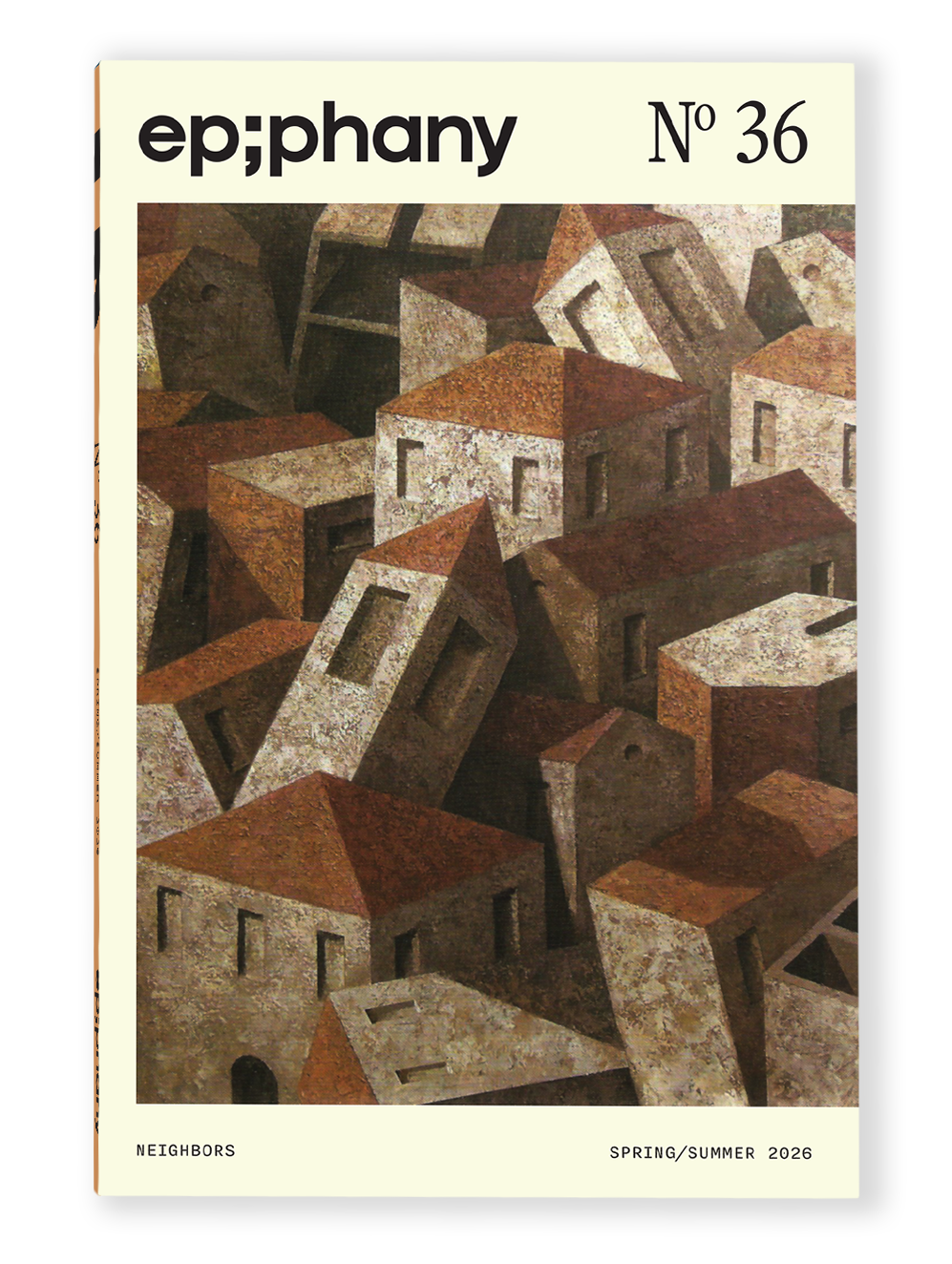
Issue No. 36: Neighbors
Spring / summer 2026
From the debauched interiors of Hugh Hefner’s mansion in Kate Durbin’s searing “House Bunnies” to a Nigerian school's backyard shitpit in Inyene Ekanem's “Ene,” to the gritty underside of North China in Zhenglong Yang's “Who We Are, Where We Go,” we take you to places of grim survival. In every piece, at every turn, with humor and heart and immense tenderness, we present characters, cocooned in loneliness, at varying degrees of reach, in the great grip of longing. What is there to long for if not for each other?
-
There she was, a stranger on the front walk. I was trying to wrestle a stubborn, terrifically uncoordinated rescue pup into a harness; she was curbing a dopey, energetic Chesapeake Bay Retriever who could've eaten my dog for breakfast. The two got to sniffing. We did the same. One line was all it took: “Wanna take this off leash?” How we use our animals for human connection.
We all have people whose odd, fleeting presence takes lasting root. A woman and her dog in my yard. Hers could play fetch for hours. Indefatigable retriever. My beagle mix toddled behind on short legs for a minute then plunked down on the grass like the flower-sniffing bull Ferdinand.
This was the early days of the pandemic—deafening sirens, helicopters, banging pots—and we were starved for it. I was new to the awkward dance of dog parenting and she cut through the crap. I don't mean merely the painstaking detail with which she shared how she regularly expressed her pup's troublesome anal glands. Through a wilted mask she regaled me with tales from her long career in education, the torrid adventures of her youth, abortions in Puerto Rico, marriages good and bad, challenges with adult children, both step- and estranged. She shared where she bought Brussels sprouts, the films she watched. I was reading The Friend. She turned me onto Sigrid Nunez's earlier novel The Last of Her Kind.
Every day at the same time she came. Half an hour stretched into an hour. Where else did I have to be? I sat on the porch, or my dog could sense their approach from inside, as dogs do. It went on like this for months. It went on until it didn't.
One morning I missed. A doctor’s appointment, then a drive upstate, a weekend away, and by the time I returned, she was gone. Was she offended? Was it something worse? I hadn't gotten her last name or number. She lived vaguely in the neighborhood but I have not seen her since. Not at the dog run, not in the park.
I thought about the day she came through the gate gabbing on about a Lee Martin essay from The Sun. She never threw anything away, promised to bring me a copy of the ol' thing if she could locate it. I pictured a hoarder's home towered in brittle clippings. In the piece (from February 2012, I later looked it up), she recalled Martin quoting a poem by Miller Williams called “Compassion.” She recited it in my yard. The short poem closes with: “You do not know what wars are going on down there where the spirit meets the bone.”
A neighbor. A disappearance. A line that stuck. Against the current egregious backdrop of ICE raids, we are galvanized by communities in cities like Minneapolis who are organizing to support and safeguard the vulnerable who live among us. These are some guiding thoughts that shaped issue 36. With a graceful redesign by our gifted designer Lucy Andersen and an evocative cover by Matthias Brandes, we offer you work that explores lives behind closed doors, work that dials into the “intimacy of unknowability” as the author Anthony Veasna so gracefully put it before leaving us too soon. From the debauched interiors of Hugh Hefner’s mansion in Kate Durbin's searing and timely “House Bunnies” to a Nigerian school's backyard shitpit in Inyene Ekanem’s “Ene,” to the gritty underside of North China in Zhenglong Yang’s “Who We Are, Where We Go,” we take you to raw places of grim survival. Stephanie Macias’s “Something Terrible” fetishizes the neighbor in a confronting story of race and identity. The well of private grief is tapped by 2025 Fresh Voices Fellow Sidney Logan Echevarria in “Preparations,” and saturates Mary Grimm's personal piece, “Mother-Haunted,” underscoring the overwhelming presence in absence. “Patterns,” elegantly translated from Persian by Nayereh Doosti, introduces the quietly subversive voice of Ghazaleh Alizadeh, a prominent Iranian author who never found a wide English readership during her lifetime. With signature compression, Peter Orner unearths an inner life of ache and memory in “Gilda,” while Nathan Grover's seaside “Nereid” sublimely guides us home. In every piece, at every turn, with humor and heart and immense tenderness, we present characters, cocooned in loneliness, at varying degrees of reach, in the great grip of longing. What is there to long for if not for each other?
And that's just some of the prose. The compassion continues through our poetry, for which we were honored to have Camille Rankine as guest editor. To quote her thoughts on her powerful selections:
These poems trouble what we uplift, what we revere, questioning and re-evaluating how we organize our world, and understand our place in it among others. They arrest our gaze on unexpected subjects, from the lobster of Catherine Wing’s “The Lobster Considers,” to the earthworm in Leia Bradley’s “Good Dirt,” to the omnipresent corn of Dana Ysabel De La Cruz’s “Why They Grow Corn in the Philippines” There is the longing for language and order in Madeline Gilmore’s “Appian Way,” the explosive Black diasporic web of Chekwube Danladi’s “Transatlantic,” and the worshipful passion of Lin Flores’s “Easter in Salem, 2025.” These works are a gathering of quiet attention, confrontation, grief, (ir)reverence and exultation.
Together, we give you Neighbors. Take good care of them, will ya?
—Sara Lippmann, Editor in Chief
Unlocked Pieces
Masthead
FORMAT: Title | Name
Table of Contents
* Fresh Voices Fellow
FORMAT: Author Name | Title | Category | URL (if linked)

We watch as they don’t even glance back at the dock sinking under the weight of all the people who love them too. As the ferry pulls away, I break into shoulder-curling sobs.