
The Sound of Puppets Kissing: An Interview with John Reed
John Reed harbors a restless ingenuity that prevents him from being circumscribed into one genre. The author of nine books of poetry, fiction, nonfiction, and illustrated work, his titles include A Still Small Voice (Delacorte), The Whole (Simon & Schuster/MTV Books), Snowball’s Chance (Melville House), All The World’s A Grave: A New Play By William Shakespeare (Penguin/Plume), Tales of Woe (MTV Press), Free Boat: Collected Lies and Love Poems (C&R Press), A Drama In Time: The New School Century (Profile), The Family Dolls: A Manson Paper + Play Book (Outpost19), and The Never End: The Other Orwell, the Cold War, the CIA, and the Origin of Animal Farm (Palgrave Macmillan). He’s also directed plays and films, and even played trumpet for a tree. A child of New York City, Reed grew up surrounded by artists and immersed in craft. He is continuously seeking new vessels to hold his creative chaos, from sonnets to puppets. I sat down with him in his office at The New School, where he is an Associate Professor and the Director of the Creative Writing Program (and where he served as my MFA advisor until I graduated in May 2025), to chat about his latest collection of poems, Year of Valentines (Spuyten Dyuvil).
Mary Karmelek: Year of Valentines is your second book of sonnets. What drew you to this form?
John Reed: I feel pretty comfortable in a form, I think a lot of prose writers do. When I was in graduate school at Columbia, I could see that there were these extraordinary poets who could fly without a net. The one I think about is Ann Lauterbach, who I knew in Tribeca when I was a kid. She was of my parents' generation. When she writes a poem she doesn't need any form whatsoever, and she can just run it and pace it without any need for the scaffolding that prose writers tend to prefer. I started at Columbia as a dual track, but it was really too much for me, too much psychological input. So I set aside poetry and didn't really discover a form I could write a whole poem in until I worked on the Shakespeare project, All the World’s a Grave. I took apart the normative works of Shakespeare and put them back together as a new play. Shakespeare embeds a lot of poetry in his plays. Even if there are no line breaks, it’s usually still in iambic pentameter, with quite a few sonnets embedded. When I worked within that form, I realized it was really a natural fit for me. Sonnets basically use short story structure–an argument structure. So as a prose writer, I found my little machine, and I could work through it. And then, of course, I also melted down the form as much as I could. I don't know that I'll ever have that kind of ability to work without a net like Ann Lauterbach does.
Are you thinking intentionally about meter as you write, or do you just write by ear?
The poems are all pretty much metered, but I wouldn't say they're super strict. They're closer to Shakespeare in his later incarnations, where he wasn't as strict with meter. But if you wanted to read them metrically, I think you could. The rhymes are in there, but they're usually slant rhymes, usually not hard on the ear, and they're taken out of order. It’s usually like seven lines and then the rhymes come back. I think people might call them ghost sonnets. There might be some other terms out there, but I like ghost sonnet. I feel like my poems are kind of ghosty.
You mentioned the sonnet form mirrors the short story structure. Do you think about the volta as the counter-argument, the challenge or new complication?
I do typically think of the volta. I think all of the poems pretty much have a turn, and you could find it.
Are you thinking about that as you're writing, or do you come back to it later?
I can't really plan ahead. Instead, I often think, “Oh, this is a subject that has a poem in it.” And I just keep writing until I get to that point. And sometimes I only get 11, 12 lines and I'm like, “Oh, actually there's not a full poem here.” And I'll just get rid of it, throw it away.
In your first book of sonnets, Free Boat, the poems were interspliced with narrative, something you’ve said was intended to create an identity to tie the sonnets together. Why did you forsake the narrative sections in Year of Valentines?
The best thing about Free Boat, in a way, was that structure, but it was also kind of the worst thing. It worked a little too well. I thought to myself: “It's really hard to read, like, 60 sonnets in a row. That's a lot of sonnets, Johnny. Maybe there's a way to float it on prose so people can get through it.” It started with a selection from ten years’ worth of sonnets, and then I did this little kind of free dance over the course of three or four months to bring in the prose element, like a Harry Matthews kind of thing.
It certainly changed the reading experience. Where did Free Boat fail, in your view?
I don't think it matches up, because you end up reading the prose, which is written very quickly, with the same investment that you read the poems, which is a major investment of time. So the compression of time in the poems is much more intense than it is in the prose, and I think it gives too much weight to the prose. It makes it harder to read the poems in place for what they are. I liked the visual elements on the page. I think that that's good. I just don't think the balance was quite right.
Did you write valentines before the sonnets?
Actual valentines? Sure. I think a big move for me was anonymous valentines all through grade school. Sometimes little love notes. That was the age where you would drop love notes into people's bags.
Does that relate to the way you write the sonnets? Are they dedicated to the same kinds of recipients or is it broader?
They're kind of amalgams, but as a poet when someone asks, “Was that poem about me?” The answer is always yes. But I also think that there is a kind of magic to being an artist or a writer—if you make a painting or a poem for someone it always finds them. I think it always hits the mark.
What's going on with the number eight or the infinity sign that sometimes appears in words in these sonnets? A few: “ha8r,” “l8ve, d8th” “de8d” “s8x.”
When you look at these poems, I don't think you clearly see the kind of meltdown of the New York School—this influence of language poetry that came in later, and this kind of presumption that language can't really do some things. There is this kind of infinite fracturing of languages into sub-languages. And it is a part of these poems. Of course, now it's part of so many forms. We all interact with the internet and see these layers and layers and layers, but there are still some words that just fail. And that's what it's about, the infinity sign. It's about words that fail.
The theme of missed opportunities felt very present in these poems. Missed opportunities that felt as if they were being lived out off the page.
It's interesting you say that. I feel like that is part of poems, that if something is really obvious, you don't need to write it in. It'll be there anyway, whether it's a rhyme or a direction. And that's one of the things about poetry that is differentiated from prose—it can have these parallel universes as you read through it. I do think about the kind of multiverse feeling that a poem can have.
One of these universes seems to be the childhood experience, how it affords a sort of vastness of the world, but also how lonely it can be.
I had this childhood in Tribeca where I ran around by myself, and it was marvelously free, and the city was completely empty, and you could do whatever you wanted. If you were on Sixth Avenue it was kind of creepy and crowded, but if you were off by the river or something, it was totally empty and abandoned. I've said to people, and I think it's true, that the greatest freedom is neglect. You just run around and do what you want. I think there is something kind of lonely about it, but there's also something very, very freeing about that loneliness.
How do you experience the city now, as an adult?
I've always expected to get pushed out of New York City, and it hasn't happened yet. Maybe it'll still happen. But my sense of time in the city is more from the perspective of the city. It's like a great tree, a huge tree, and you're just a squirrel to the tree, and your lifespan is insignificant to the life of the tree, but it can still love you. Years ago, after my wife's mother passed away, there was a giant tree in her backyard that had loved her. It was really heartbroken when she passed, and we gave the tree hug therapy with the kids that summer. It seemed to be helping. I would sit on the porch and practice my trumpet, just noodling around in the blues scale. And the tree said to me once, “Thank you for playing the trumpet for me.” And I said, “Oh, I'm not really playing for you. I'm just out here in the back noodling around in the blue scale.” The tree said, “Thank you for playing the trumpet for me,” because it knew better in this way that I couldn't possibly understand. It recognized I was a squirrel.
You have a great ability just to see how the world is working on those multiverse levels, and give it as much weight as what other people traditionally see.
I think it's important to continue to generate good ideas and creative ideas in environments that have a fair amount of chaos. The city can be really tough on you and will only give you just exactly what you need. But if the city has a need for you, it's not going to let you go. I do have a very spooky relationship with the city itself, almost religious or something.
Have you always had that?
I think I developed it as a kid just walking around the city.
Were you ever composing in your head when you were a kid? The way you composed these sonnets.
I was always working on projects, but they were pretty silly. When I was a kid, there was a film I was working on with Miles Lally (the son of Michael Lally, the poet). And we had all kinds of plans to make a giant movie. He took notes upon notes and bought stuff and made props. We were always working on projects like that with my friend Harry Smith, who was the son of Richard Smith, who was a well-known painter. We did all kinds of crazy things. We made a figure on a roof and set it on fire. Harry was a complete pyromaniac. He caught fire several times. We were always dreaming up projects.
You still always have a project going on. You’re always researching for something that's coming. What are you working on now?
I have a new project I'm dying to do. There was this painter I grew up with, Walter Robinson, who also started Artnet magazine. He was really a fish out of water in his moment because he was working with these tropes that felt very Americana, kind of quaint and figurative in a moment when abstraction was the dominant language. He passed away recently, and I have this project I'm thinking about where I work through Walter’s images that I have the rights to, and write text that would be on the right side of the image. I don't know if I'm actually going to do it, but I've been curious enough to start working on the project, using images from his work, as well as my mother's work. I would have them fabricated alongside a separate panel that I would make of writing, so it would be like a book.
This is your mother’s, Judy Rifka, artwork on the cover of Year of Valentines, right?
Yeah. It’s actually from this project that Walter worked on. He would print these pages from Artnet and give them to artists. They would draw whatever they wanted on them and sell them for a dollar or two. And my mother was like, “Walter, just give me a couple hundred.” So she just drew right on them. There were a million of them. They were influential, and very political too. She did a bunch of AIDS-related ones.
How does the interdisciplinary nature of the work that she was doing influence the way you work?
Both of my parents were working that way. They were super young when they had me, and this is the two of them probably right before.
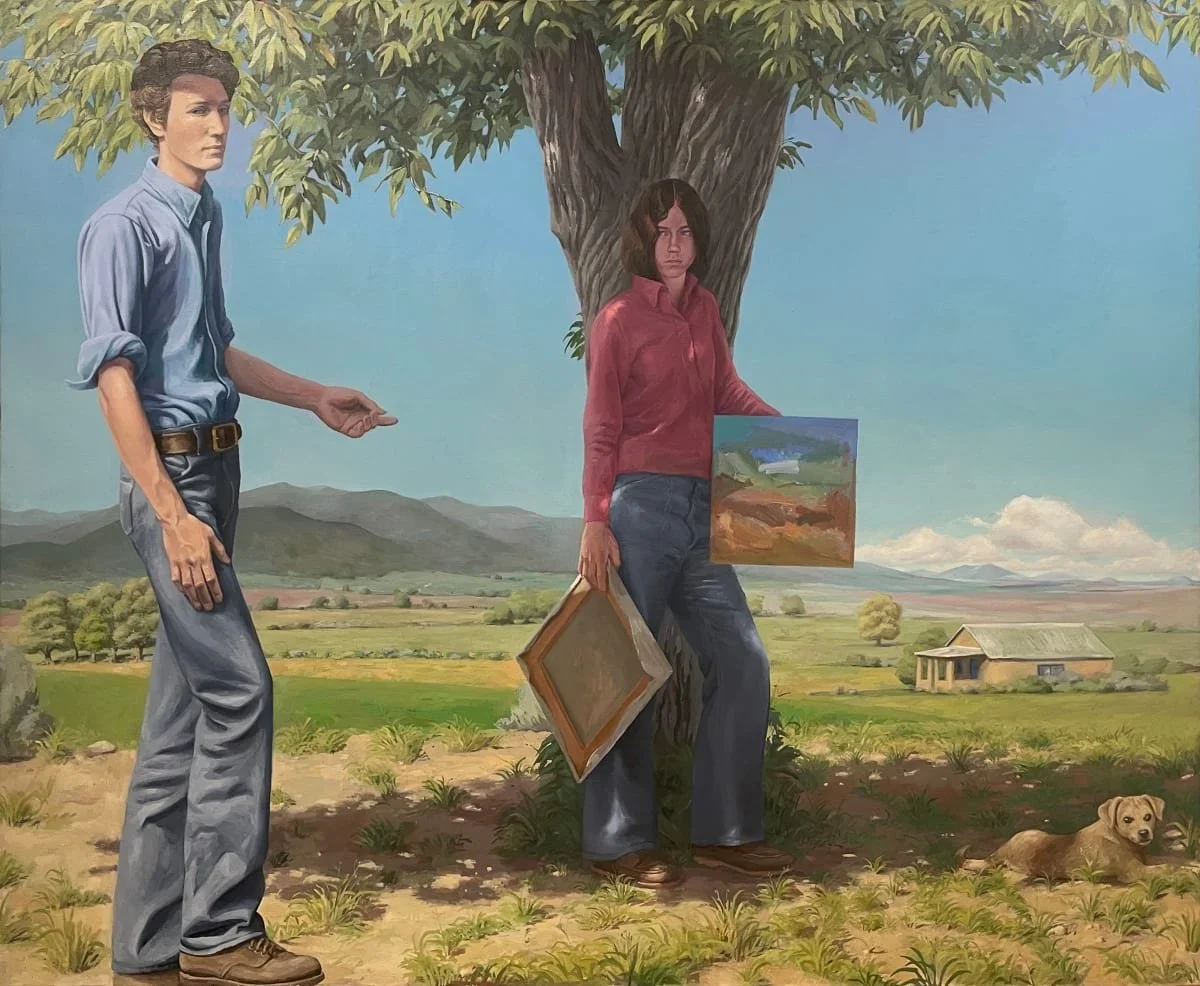
AMoCA Collection: Willard Midgette, Porch, 1967, Oil on Linen, 77.75 x 98 in.
Wow. Who did that?
Willard Midgette. He was kind of a mentor to both of them. They both worked interdisciplinary. My father (David Reed) was more of an abstract person, but my mother was singing and doing performances at the Mudd Club. I was just thinking about a song of hers that she would sing, a song I would hear her rehearsing the lyric that went, “Fade away and radiate…fade away and radiate.” “Fade Away and Radiate” by Blondie. I was thinking about this because, Rene Ricard, who lived in our loft and was a poet, wrote the piece, “The Radiant Child.”
So she was the radiant child.
Yeah. The new Keith Haring biography by Brad Gooch doesn’t mention it. Brad was around my mother’s studio quite a bit…but that's part of the history of erasing women from the East Village scene, which they started.
Was she considered part of the No Wave scene?
She definitely was part of it, but she was also not a joiner in some ways. So I don't know. She was important in a lot of those scenes, but I don't know if I would say that she was part of it.
Let’s talk about puppets. How long have you been interested in them?
I think I traced my interest in puppets back to the very first puppet shows I saw with large wooden marionettes. They were almost humanized. And that was at the library over on Seventh Avenue in front of the Carmine Street pool. Those puppet shows were super intense and scary. But I got interested in them then. Midgette also had quite a puppet collection. His kids and I would go play with their puppet collection. Also my grandmother had quite a puppet thing going on. Puppets are fascinating because they are a perfect expression of the animus that we're these meat things—we suddenly have life in us and then it's vacated. And when you put your hand into a puppet it's the magic of being alive, the distillation of consciousness.
It reminds me of what you said earlier about the difference between the time it takes to read poetry and the time invested in prose. Puppet time feels akin to poetry, like the intensity of having to really manipulate time and movement and action and thought.
That's true. When you're working a puppet it insists on self-actualization. At least, in the puppet body it does. Most of the time we walk around thinking of ourselves as conscious, but most of the time we're not. Most of the time we're on autopilot.
How does the idea of love relate to puppets?
There is a sonnet in Valentines where two wooden puppet heads are trying to kiss. They kind of turn and just clack-kiss together in marionette shows. It's so wonderful and so romantic and it just never works. It doesn't really work.
So puppets aren’t capable of love?
Well, I think they're certainly capable of trying.